
Breaking down what they were actually selling — and how to apply it to your business
By Mari Miavka · Reading time: 15 minutes
Introduction
In 2017, a 25-year-old guy from London named Ben Amanna launched a boxing apparel brand. The first sale happened within an hour of the store opening. Then came a year and a half of silence. And then — steady sales, $8 million in revenue over two years, a team that grew sevenfold, and a brand that champions wear today and dozens of adjacent sports niches are copying.
Ben entered a market where Everlast, Rival, and Grant had owned the image of "sweaty gyms and gloves" for decades, and Nike and Adidas had marginal boxing lines as a side-business. He didn't try to outspend them. He didn't pay influencers. He didn't pour millions into advertising. He didn't launch with a loud PR campaign.
He did something different. He created a category none of them were covering: boxing as lifestyle, not fight night equipment. Not clothes for the ring — clothes for the journey. Not for the moment of victory — for the years of discipline before it.
And that very thing — knowing your customer, loving your niche, not trying to take the whole market — became the engine of his growth. This principle will repeat throughout the article in different forms. Six philosophy levers. Seven sales mechanics. Eight customer retention elements. All of them are built on one foundation: a deep understanding of one type of person for whom this brand exists.
I started breaking down BOXRAW because I wanted to understand exactly what they did right — and found a system that can be applied to any business with a real product but an invisible online presence. None of the principles require a budget. All of them require thinking.
If you're thinking about your own business right now — pause. As you read, place each lever against your own situation. That is the work. Not mine — yours.
Everything in this article is part of a system I build with clients. If at any point you want to see how it applies to your business — there's a link to a free strategic audit at the end. If not, take what's useful and run with it.
Part 1. Philosophy: 6 Levers That Make a Brand Sticky
Most businesses believe the problem lies in marketing, in content, in the Instagram algorithm. The real problem runs deeper. Here are six levers that either work in your brand — or don't. And when they don't work, no marketing will save you.
Lever 1. One idea that everything reduces to
BOXRAW has one phrase. "Boxing is Way of Life."
This is not a slogan. It's a filter through which every decision passes. Does this product speak to the boxer's way of life — or is it just a T-shirt with a logo? Is this post about discipline and the journey — or is it just a photo with a discount? Does this ambassador live this philosophy — or are they just popular?
If yes — it's BOXRAW. If no — discard.
Most businesses don't have this. They have three values on the website, a one-page manifesto, "our mission is to help clients achieve their goals" — and zero clarity. Because when everything matters, nothing does.
What this looks like in another niche:
A cycling boutique that positions itself not as "bikes and accessories," but as "Cycling as a daily ritual, not a weekend sport" — one phrase through which every decision passes: which brands to carry, how the shop looks, who to collaborate with, what event to run once a month. Everything else — discard.
Ask yourself right now: if your business closes tomorrow — what will people miss most? Not the product. Not you. What feeling did they get from working with you? That is your one idea. Not three. One.
If you can't articulate it in one sentence that someone hearing about you for the first time would understand — you don't have a brand. You have a business. Those are different things.
Lever 2. Deliberate pattern disruption within the niche
Look at any 10 businesses in your category. They look the same. The same photo style, the same color palette, the same motivational quotes, the same website structure. This is not accidental — everyone looks at their competitor and copies, because "that's how it's done."
And that is precisely why none of them are remembered.
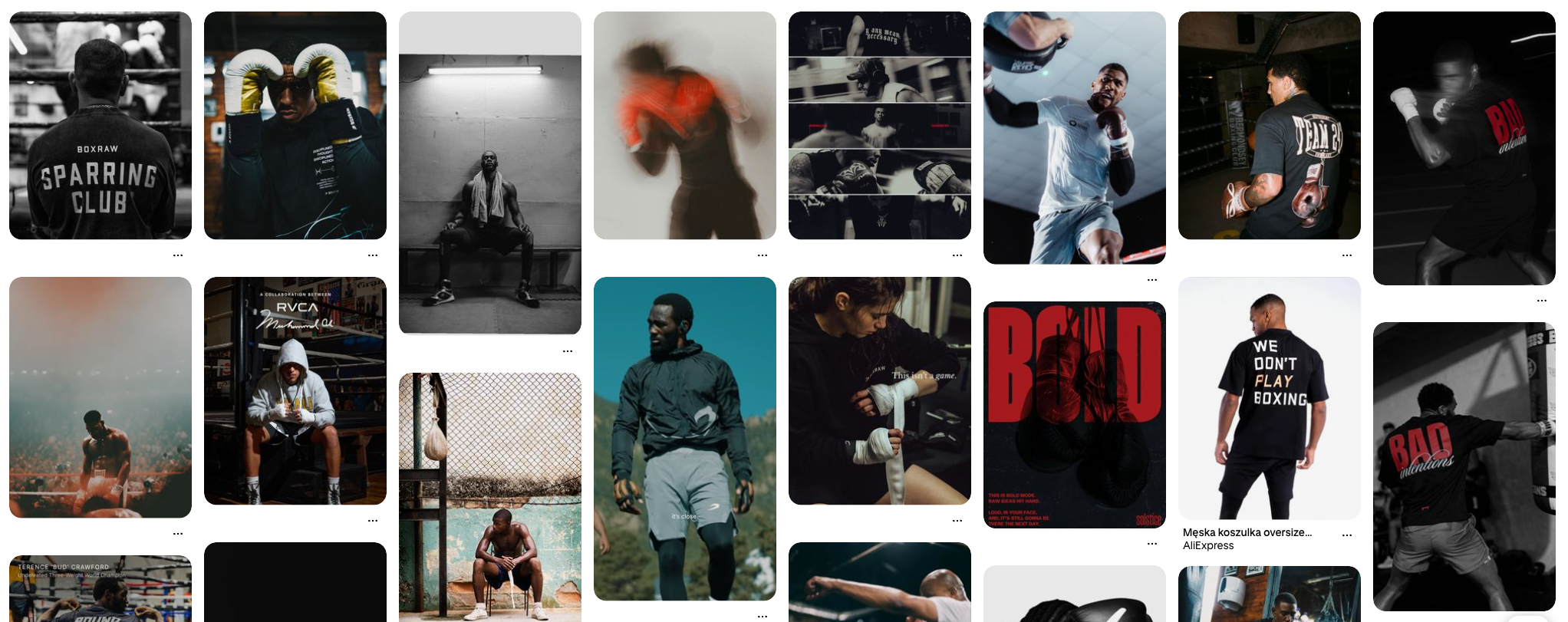
BOXRAW entered a niche where every brand looked like sports equipment — aggressive fonts, red-black palette, photos of fighters at the moment of impact, "warriors" and "champions" language. Ben did the opposite. BOXRAW looks like a streetwear brand from Brooklyn or Tokyo. Minimalism, clean colors, typography that references old boxing posters through a modern editorial filter. The language isn't "warrior mindset" — it's "Boxing is Love".
The brand sounds like a poet who trained at a boxing gym, not a coach who learned marketing clichés.
What this looks like in another niche:
A BJJ academy where all competitors use the same codes — black-and-blue colors, aggressive photos in gi, motivational quotes in the spirit of "warrior mindset." Deliberate disruption: positioning as a "scholar's aesthetic." Architectural photography of the space, typography with scientific seriousness, language that frames it as an intellectual discipline, not a combat sport. Chess on the tatami, not a brawl. Everything different — and that is precisely why it's recognizable.
That is the key. Not "be creative." But deliberately disrupt one expectation of your niche. One. That's enough.
Stop and think: what visual or verbal code does everyone in your category use automatically? What happens if you do the opposite? Not as protest — but from a clear understanding of who you're doing it for.
This is the cheapest and most powerful differentiation strategy that exists. And almost no one uses it because it's scary to step outside the template. But stickiness begins precisely there.
Lever 3. Specifics instead of abstractions
"Quality product" disappears from memory in a second. "Leather gloves, hand-stitched in Italy" — stays.
Look at how BOXRAW speaks. Instead of "we're about discipline" they write "You can't cheat the grind." Instead of "we're about community" — the concrete story of BOXRAW Foundation, which uses boxing as a mechanism for social change in places where young people have no access to sport. Instead of the abstract "quality" — details about fabrics, weights, how the garment fits a boxer's body in motion.
Every brand claim has substance. An image you can see. A detail you can verify.
What this looks like in another niche:
A premium Pilates studio. Instead of "we have a cozy atmosphere" —
"We always have a warm floor, a vinyl record playlist, and eucalyptus-scented towels after every session. Once a week — a private physiotherapy session for all members."
Detail, image, ritual. Concrete. This text belongs only to this studio and cannot belong to another.
Now open your website or Instagram bio. Does it say something like "we help our clients achieve their goals through personalized service and expert guidance"? Or "we create unique solutions for your business"? That's zero specificity. This text fits anyone in your niche — which means it belongs to no one.
Try right now: take one phrase from your website that sounds "right." Rewrite it so it becomes a detail that only your business can say. Not "we value our clients" — but "every new client gets one private consultation before the first order; we don't start work until we understand why you came and what you're afraid of."
A specific detail does more for a brand than a page of values.
Lever 4. Internal credibility, not external
Most businesses try to prove their quality through external signals: certificates, photos with notable people, press quotes, "10 years of experience." This works poorly. Because every competitor does the same thing.
BOXRAW was built on something different. Ben has been a real boxer since age 12. University boxing club, national championships, experience in boxing events beyond apparel. He's inside the culture. And it shows in every detail — from the cut of the shorts to how he talks about bag work.
The brand doesn't try to prove its authenticity. It simply speaks the language that only an insider can speak. Boxers recognize their own. Everyone else — not the target audience.
And paradoxically, this created desirability for non-boxers. People who have never stepped into a ring wear BOXRAW because they want to belong to an authentic culture. Credibility creates outward magnetism.
What this looks like in another niche:
A ski school in the Alps. Instead of "we'll teach you to ski" — details that only an experienced rider would recognize: specific off-piste routes known only to local guides; a training philosophy drawn from Aksel Lund Svindal or a chosen Scandinavian approach; mention of specific snow conditions and how to read them. This is the culture's insider language, and it attracts serious riders, not casual tourists.
A question for you: what details of your business will only someone who deeply understands your field notice? What are you currently hiding because you think "it's not for everyone"? Show them. To an outsider it seems "niche." To an insider it signals: this business is serious. And that is what makes it a magnet.
Stop trying to appeal to everyone. Start speaking the language of your own — and the outsiders will come, drawn to what they don't have.
Lever 5. Emotion, not function
Nobody responds to statistics. Everyone responds to one face, one story, one emotion.
BOXRAW describes boxing as love. Not as a sport, not as a fitness option, not as self-defense. As love. A dedicated "Boxing is Love" page exists precisely for this — as an emotional anchor.
It doesn't talk about technique. It talks about what boxing does to a person: brings you back to your body, clears your head, gives you a space where you can be yourself without words. Ben himself started boxing at 12, escaping bullying. This isn't a PR story — it's the operational core of the brand. Boxing saved him. He builds a brand for those whom boxing will save the same way.
This is an entirely different frequency than "be a champion."
What this looks like in another niche:
An outdoor apparel brand for skateboarding and street culture. Instead of "technical fabric specifications" — a narrative about
the feeling of the first successful landing after 100 falls
. The moment when the body remembers. This isn't about durable clothes. It's about a moment of triumph and freedom after stubbornness. And the customer is buying precisely that moment, wrapped in fabric.
Now you. What emotion underlies your business? Not results, not metrics, not a "value proposition." What happens to the person at depth when they work with you?
Perhaps it's a return to their own taste after years of doing what was "right." Perhaps it's inner silence after a week of noise. Perhaps it's permission to be imperfect in order to become real — a rare permission in the adult world.
A sticky brand names that emotion out loud. Not as a slogan — as an operational truth around which everything else is built. Most businesses are afraid of this, because it seems "unprofessional." That is precisely why they are not remembered.
Lever 6. A story worth retelling
The last and most powerful lever. The brain stores stories, not lists of facts.
BOXRAW has one central story that is easy to retell: a boy who was bullied at school started boxing at 12, grew up to be a boxer, and built a brand where boxing is not a sport but a way of life that saves people. That's it. 30 seconds. And this story carries all five previous levers — simplicity, unexpectedness, specificity, credibility, emotion.
Every post, every ambassador, every product is an episode of the same story. The brand does not wander between topics. It deepens one narrative.
Now honestly: what one story underlies your business? Why does it exist at all? Why did you, specifically, launch it?
Most owners cannot answer this in 30 seconds. They either start with biography ("I worked 10 years in the industry, then..."), or with the market ("I saw that no one was offering..."). These are not stories. They are résumés.
A story is when there is a turning point — concrete, with emotion — that explains why this business could not help but exist. Ben didn't "decide to go into business." Boxing saved his life at 12 — and he builds a brand that passes that forward. That is the story.
Find yours. Tell it honestly. Repeat it in different forms — in your Instagram bio, on the "About" page, in the first conversation with a client. A story is the glue that holds all the other levers together.
Without it, your business remains a service. With it — it becomes a brand.
Part 2. Mechanics: How They Turn Culture Into Money
Reading time: 7 minutes
Philosophy without a sales machine is a nice manifesto on a website nobody sees. BOXRAW grew not because it had a beautiful idea. It grew because it built a system. Here is how that machine works, step by step.
Why they started with community, not product
Before launching the store, Ben had an Instagram audience of around 20,000 followers. Not paid. Organic. He spent a year+ talking about boxing and its philosophy, building a community around an idea before there was anything to sell.
This is the first secret. Most entrepreneurs do the opposite — they create a product, then look for an audience. BOXRAW built an audience, then launched a product into an already existing community. The first sale within an hour of launch was not luck. It was the result of a year of prior work with the audience.
Lesson: if you're building a business right now — start with content and community, not product. One or two posts per day about your philosophy, your vision, your perspective. After 6–12 months you have an audience waiting for your launch. Without this, day one will be silence.
Seeding instead of advertising
BOXRAW didn't pay influencers in the conventional sense. Instead, they sent product free of charge to boxers, coaches, and boxing gyms. Not for a post. Not for a mention. Just gave — to people who belong to the culture.
What happened next: these people started wearing the product because they liked it. Organic mentions emerged, coaches appeared in BOXRAW at sparring sessions, champions wore it at tournaments. This created social proof from inside the culture, not purchased from outside.
A paid influencer looks like advertising. A coach wearing your brand during training because it's comfortable — looks like truth. These are fundamentally different currencies of trust.
Lesson: instead of "buying" attention — give value to people already inside your target culture. Give a free consultation to 10 of the right people. Make a free mini-product for the first 50 clients. Offer your expertise without charge to those whose voice carries weight in your niche. This isn't a "discount." It's an investment in trust that returns as organic referrals.
Drops instead of a permanent catalog
BOXRAW doesn't release products continuously. They do limited-edition drops. Each drop is a media event: announcement, building anticipation, release, sold out, then — a pause, and again.
This works for two reasons. The first is scarcity psychology: when a product is limited in quantity and time, the brain reacts more sharply, the person buys faster, FOMO does the work. The second is creating a rhythm to which the community becomes attached. People start anticipating the next drop the way fans await an album from a favorite artist.
A permanent catalog is a supermarket. Drops are a cultural event.
Lesson: even if you sell a service rather than a product, you can create a release rhythm. Close applications for your consulting quarterly, open them once every three months. Launch new packages as "collections" — limited time, limited number of spots. Create seasonal offers instead of permanent ones. This makes you an event, not a service on a shelf.
Affiliate program without discounts
Most brands use affiliates through discount coupons ("enter code AMBASSADOR15 and get 15% off"). BOXRAW deliberately did not go this route, because discounts destroy premium perception. A brand that constantly lowers its price trains the customer to wait for a sale, and the full price becomes the exception.
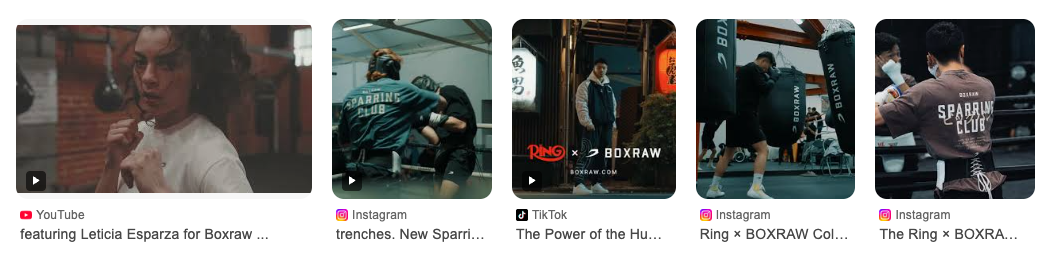
Instead, BOXRAW built an affiliate network of boxing bloggers and small media, where partnership was about access and status, not discounts. Partners got early access to collections, exclusive materials, joint projects. The brand stayed premium, and partners received reputational value, not a cheap commission.
Lesson: if you're an expert — don't discount your work through partners. Instead offer joint projects, co-publications, access to your audience. Partnership should raise your status, not lower it. A discount is a weak currency. Status is a strong one.
Funnel on Shopify Plus
Technically, the entire BOXRAW machine runs on Shopify Plus — a serious enterprise version of the platform. What matters for us:
- Email/CRM sequences after the first purchase — a series of letters that deepen the connection to the community (stories, culture, upcoming drops), not just "buy more"
- Welcome flow for new subscribers — when someone leaves their email, a prepared sequence begins that takes them from "interesting" to "I want this"
- Launch campaigns — coordinated drop launch campaigns through email + Instagram + ambassadors on the same day
- Database segmentation — new subscribers, first-time buyers, and regular customers receive different messages, not one template for everyone
Lesson: your email list is an asset that no one can take from you (unlike Instagram, where the algorithm can kill your reach tomorrow). If you're not collecting emails yet — start this week. A simple lead magnet (an article like this one, a checklist, a mini-course) + a basic 5-email welcome sequence is the minimum machine from which everything else begins.
The content machine: proportion, rhythm, voice
The final layer of mechanics — what their content actually looks like. BOXRAW posts daily, predominantly on Instagram. But the proportions matter:
- Approximately 70% — cultural content (stories, philosophy, athletes, training, "boxing is way of life")
- Approximately 20% — product content, but embedded in culture (an athlete in gear during sparring, not "buy this T-shirt")
- Approximately 10% — direct promos (new drops, collaborations, events)
This is the inverse proportion of what most businesses do. Most publish 80% product content with direct selling — and are ignored. BOXRAW publishes 70% value, and when they sell — the community buys, because it already trusts.
Lesson: check your Instagram. If most posts are "buy," "discount," "new product" — you're on the wrong track. Give 70% value and culture. 20% — hints at product in a cultural context. 10% — direct selling. This doesn't work instantly, but it works consistently.
Want to apply this to your business?

Part 3. Lifecycle Architecture: How They Retain Customers for Years
Reading time: 5 minutes
The most powerful part of BOXRAW's sales machine is not the launch. It's what happens after the first purchase. Most brands think: "we sold — great." BOXRAW thinks: "we sold — now the work begins."
I spent an evening going through all the sales mechanics on their website and found a complete customer retention architecture that works for years. I'll break down each element.
Black Card — tiered loyalty with four levels
BOXRAW has a loyalty program with four tiers: Bronze, Silver, Gold, Platinum. Progress is based not on monthly spend, but on lifetime spend — that is, how much the customer has spent over the entire time they've been with the brand. This creates a long horizon: the customer doesn't think "I'll buy once," but "I want to reach Platinum over two years."
Each tier earns a different number of points per $1 spent — 5 on Bronze, 10 on Silver, 20 on Gold, 30 on Platinum. A Platinum customer earns rewards six times faster than a Bronze customer. Exponential rewarding of loyalty, not linear.
But the most interesting part is that rewards progress materially. Bronze gets no free gift at all. Silver — a water bottle and sticker pack. Gold — hand wraps and a mesh bag. Platinum — a cross body bag. Each tier is a new physical symbol of belonging.
This is not accidental. It's the belt system from martial arts, transferred to an apparel brand. Bronze is the white belt. Platinum is the black belt. The customer isn't just buying more. They are on a journey.
Quick Ways to Earn Points — gamification from the start
BOXRAW awards points for actions that don't even require a purchase:
- 50 points for following on X
- 50 points for Instagram follow
- 50 points for Facebook like
- 500 points for a review
An inexpensive way for the brand to build social proof, and simultaneously — a way for a new customer to "start playing" the loyalty system from zero.
The psychological move here is deep: a new customer who hasn't bought yet is already invested in the system. They've already left a review. They've already followed. Now not buying means losing what they've already accumulated.
How It Works — simplified funnel
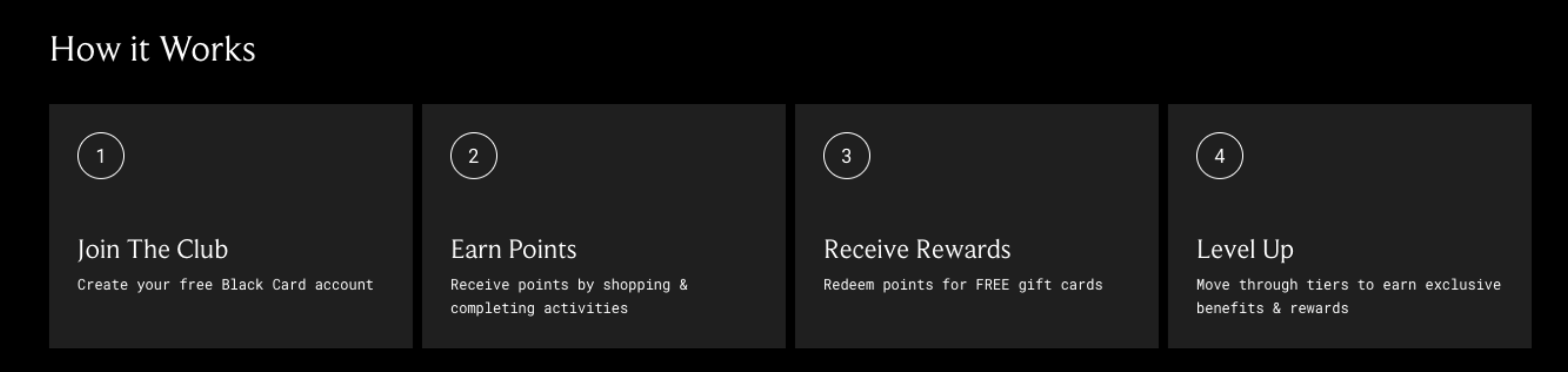
The entire program is explained in four steps: Join → Earn → Receive → Level Up. That's it. No complex UX. A child would understand in 15 seconds.
Notice the language: "Move through tiers to earn exclusive benefits & rewards." Not "buy more to get discounts." But "move through" — like a game, like a journey.
Refer a Friend — members only
The referral program is available exclusively to Black Card members. $30 per referral. This means: only customers who have already engaged with the system have access to referral bonuses.
This is again exclusivity as a mechanism — not "please share with friends." But "as a member of our community, you have the privilege of inviting others."
Pro Card — the inner circle of "your own"
A separate program for actual boxers — amateur and professional. Amateurs upload a photo of their boxing card. Professionals share their BoxRec profile URL. Only after verification does the brand grant special access.
This is not a discount. It is recognition of belonging. The same product, but a different emotional weight.
Students and veterans — discounts through verification
BOXRAW doesn't simply give discounts to students and veterans. They use external verification systems:
- StudentBeans for students
- ID.me for military and veterans
The discount is tied to verified identity, which preserves premium perception. Discounts only destroy a brand when they're available to everyone. Identity-based discounts — strengthen the brand.
Newsletter signup with reward
Subscribing to the newsletter delivers a discount code by email within 30 minutes. A classic lead magnet mechanic, but executed cleanly and confidently — without aggressive "GET 15% OFF NOW!!!"
The tone: "Sign up for updates on the latest releases and promotions." Calm. Grown-up. Premium confidence.
The overall lesson about lifecycle architecture
Retention is architecture, not a function. Most businesses build sales and forget about retention, then complain about the high cost of acquiring new customers.
If you're an expert or space owner, ask yourself: does your business have a progression system for regular clients? Are there tiers, statuses, rituals of belonging? What does a client get after a year of working with you — beyond what they got on the first day?
If the answer is "the same thing" — you don't have lifecycle architecture. You have a service. Lifecycle architecture transforms a service into membership, and that is a fundamentally different economics.
Part 4. Adaptation for Three Types of Sports Businesses
Reading time: 3 minutes
I work with three main types of clients, and the BOXRAW model adapts to each in its own way. If you recognize your business in one of these descriptions — you have a concrete starting point.
1. Martial arts apparel or gear brand
Here the BOXRAW model works almost one-to-one. You're not selling T-shirts or gloves — you're selling the identity of the journey. Content should be about training, mentality, ritual, technical details, athletes' stories — not about fabric construction.
Starting point: choose one martial art as the core (BJJ, Muay Thai, MMA, boxing — one thing), don't try to be a brand for everyone. Build aesthetic + language + values systematically. Launch ambassador seeding in gyms and among coaches. Work with drops, not a catalog. Build an affiliate program with athletes, not random bloggers.
Lifecycle architecture: tiered membership based on lifetime spend. Free gifts progress materially. Pro Card for active fighters with verification through the local federation. Referral program — members only. Student discount through StudentBeans.
2. Premium fitness club
Here the model needs to be adapted, not copied. Your "product" is not a membership. It's status, environment, ritual, and result. Marketing should sell not gym access, but transformation, belonging, a private atmosphere, high standards.
Starting point: content about people and progress, not equipment. Introduce a waitlist or application-style entry — this raises perceived value. Partnerships with local founders, creators, medical professionals. Referral loop: member brings member. Closed events: recovery nights, performance labs, member-only sessions.
Lifecycle architecture: tiered not by spend, but by membership duration or achievements. Member 6 months → 1 year → 2 years → Founding Member. Each tier provides material symbols: a watch with the club logo, a hoodie only for members of 1+ year, an engraved water bottle for 2+ years, a separate locker room or lounge for Founding Members.
You're not selling a gym. You're selling a space people want to belong to.
3. BJJ or MMA academy
This is nearly the ideal niche for the BOXRAW approach, because BJJ has a strong culture, rituals, and a high-identity community. You're not building a "gym" — you're building academy culture: belt, progress, brotherhood, humble confidence, technical mastery, the long journey.
Starting point: video series "from white belt to..." — documenting the journey of real members. Instructor-led storytelling — your training philosophy, your lineage, your approach. Open mats, seminars, member spotlights as regular rituals. Merch as part of the gym's culture — not for profit, but as a sign of belonging.
Lifecycle architecture: the most natural fit here — the belt system already exists. Use it as the foundation. White → Blue → Purple → Brown → Black not only as technical progression, but as brand progression:
- White belts receive a welcome kit with gi, patch, academic notebook
- Blue belts — a different version of the patch, T-shirt for blue belt and above only
- Purple belts — medals, photo in the hall of fame, opportunity to assist in beginner training sessions
- Brown belts — instructor pathway, access to seminars by global black belts
- Black belts — life membership, free access to all academy seminars
Pro Card — for those who compete in tournaments representing the gym. Referral — only for members of 6+ months with blue belt and above. Creates a culture filter — new members come through those who understand the culture.
In all three cases the formula is the same: first culture and community, then product or service, then scale through trust, then retention architecture that transforms clients into members. What differs is only the form that culture takes.
Checklist for Those Who Own a Business
If you're a business owner, an expert building a personal brand, or someone just launching a project — here are the points worth checking this week.
Want to apply this to your business?
What's Next
If this article gave you a thought you can't fall asleep with — good; it means something important stuck. Don't try to do everything at once. Choose one lever and one mechanic from the entire list, work on them for two weeks. After two weeks — the next pair. This is a quarter's work, not a weekend's.
And now for those thinking: "this isn't about my business"
I've prepared appendice to this article — for businesses that look distant from sports but operate on the same principles.
Appendix — how this philosophy transfers to expert practices with brand culture in their DNA: wealth advisors, custom software studios, independent architects. Read Appendix →
If you want to do this together
Somewhere right now, your ideal customer is looking for exactly what you do — and not finding you. Not because you're not good. Because your online presence doesn't say what you are. I fix that. I go through everything your customer sees, find where the gap is, and rebuild it in the words that make them choose you.
We look at your current voice, your positioning, and exactly where the gap is.


